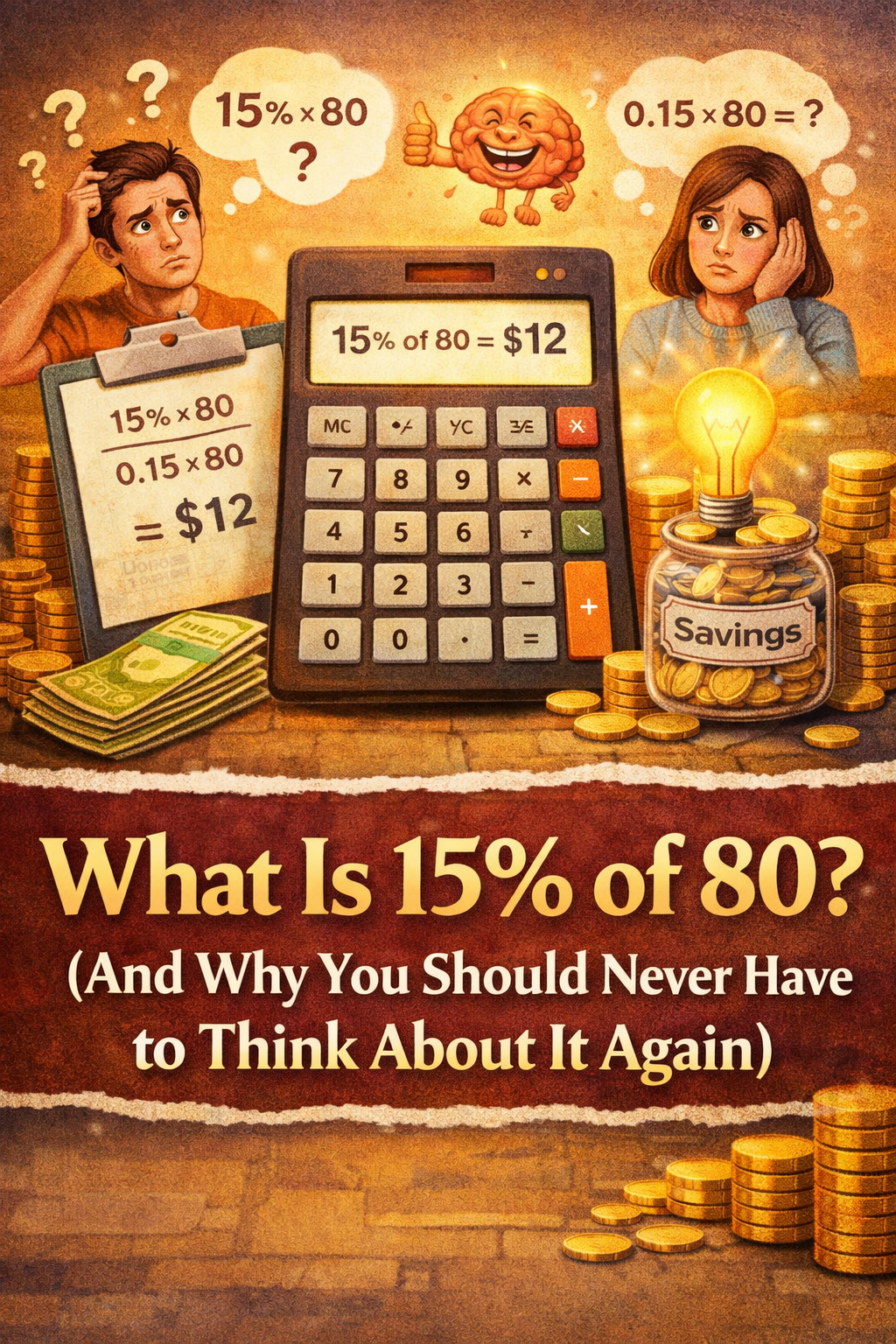
Let’s just get it out of the way: 15% of 80 is 12.
There. Done. But if you’re still reading — good. Because that number alone doesn’t tell you much. What you probably want to know is: how do I figure this out on my own, why does my brain always freeze at percentage questions, and is there a faster way that doesn’t involve embarrassing mental gymnastics at a restaurant table?
This article answers all of that. And yes, there’s a free tool at the end that does the heavy lifting for you — in under a second.
The Quick Answer: What Is 15% of 80?
15% of 80 = 12
Here’s the math behind it, kept as simple as possible:
- Convert the percentage to a decimal: 15% = 0.15
- Multiply: 0.15 × 80 = 12
That’s it. The universal formula is: Percentage ÷ 100 × Number = Answer
So for any percentage question in this format, you just divide the percentage by 100 and multiply by your number. Clean, repeatable, always works.
Why Percentage Questions Trip People Up
Here’s something you might not expect: percentage confusion isn’t a you problem. It’s a how-we-learned-math problem.
Most of us were taught percentages in the abstract — X% of Y, with no real-world context attached. So when you’re standing in a store trying to figure out if a “30% off” deal is actually worth it, your brain stalls. It’s trying to run a formula it was never properly wired to real life.
The other issue? There are actually three different types of percentage questions, and they require slightly different thinking:
- What is X% of Y? → e.g., What is 15% of 80? → Answer: 12
- X is what percent of Y? → e.g., 12 is what percent of 80? → Answer: 15%
- X is Y% of what number? → e.g., 12 is 15% of what? → Answer: 80
Most basic calculator apps only solve the first one. That’s why people get stuck when the question is phrased differently.
Real-World Examples Using 15% of 80
Numbers make more sense when they’re attached to something real. Here’s where “15% of 80” actually shows up in daily life:
At a Restaurant
Your bill comes to $80. You want to leave a 15% tip. That’s $12. Hand over $92 and you’re golden — no phone needed, no awkward pause while you tap at your screen.
At a Store Sale
An item is originally priced at $80 and has a 15% discount. The saving is $12, bringing the price down to $68. This is also how “sale math” can fool you — 15% sounds significant until you realize it’s only $12 off an $80 item.
In School Grades
If an assignment is worth 80 marks and is weighted at 15% of your final grade, that assignment contributes 12 points toward your total. Suddenly that grade doesn’t feel so abstract.
In Finance & Savings
You have $80 set aside and want to put 15% into an emergency fund. That’s $12 moved to savings. Small number, but understanding percentage-based saving is exactly how consistent financial habits get built.
Mental Shortcuts for Percentages (No Calculator Needed)
If you want to handle percentage math faster in your head, these tricks genuinely work:
The 10% Trick
Always start with 10%. To find 10% of any number, just move the decimal point one place to the left.
- 10% of 80 = 8
- 5% is half of 10% → 4
- 15% = 10% + 5% = 8 + 4 = 12 ✓
Once you internalize this, percentages like 15%, 20%, 25%, and 30% become almost instant.
The Flip Trick
Here’s a little-known gem: X% of Y = Y% of X.
So 15% of 80 is the same as 80% of 15. Which one feels easier to compute? Sometimes flipping the question is all it takes to make it click.
The Fraction Shortcut
Some percentages have simple fraction equivalents that are faster to work with mentally:
- 25% = ¼ of the number
- 50% = ½ of the number
- 75% = ¾ of the number
- 20% = ⅕ of the number
- 10% = ¹⁄₁₀ of the number
15% isn’t a “clean” fraction, but breaking it into 10% + 5% gets you there just as fast.
Common Percentage Mistakes (And How to Avoid Them)
Even people who are confident with math stumble on these:
Confusing Percentage Points with Percentage Change
If a tax rate goes from 15% to 20%, it increased by 5 percentage points — but it increased by 33% as a percentage change. These are two completely different things. Mixing them up leads to real misunderstandings in financial news and contracts.
Applying Discounts Twice
A 20% discount followed by another 20% discount is not a 40% discount. The second discount applies to the already-reduced price. This is how retailers advertise “extra 20% off sale prices” while the actual total saving is much less than it sounds.
Mixing Up “Of” and “Off”
“15% of 80″ (= 12) is very different from “15% off 80″ (= 68). One tiny word, two very different answers. This trips people up constantly — especially on price tags and invoices.
Stop Doing This in Your Head — Use a Percentage Calculator
The mental tricks above are genuinely worth knowing. But in real life — mid-conversation, mid-shopping trip, mid-invoice — you don’t always have the mental bandwidth to work through the steps.
That’s exactly what Decimaly’s Percentage Calculator is built for. It handles all three types of percentage questions in one place:
- What is X% of Y?
- X is what percent of Y?
- X is Y% of what number?
No login. No ads. No irrelevant clutter. Just type in your numbers and get your answer — clean, instant, and correct.
👉 Try the Percentage Calculator at Decimaly →
Frequently Asked Questions
What is 15% of 80 as a fraction?
15% of 80 = 12. In fraction form: 15/100 × 80 = 1200/100 = 12. You can also simplify 15/100 to 3/20, so 3/20 × 80 = 12.
What is 15% of 80 dollars?
$12. Whether it’s a tip, a tax, or a commission on an $80 amount, 15% always gives you $12.
What is 15 percent off 80?
If 15% is being subtracted as a discount, the final price is $68. You take $12 off $80: 80 − 12 = 68.
How do I calculate 15% without a calculator?
Take 10% of the number (move the decimal left), then add half of that for the extra 5%. For 80: 10% = 8, 5% = 4, total = 12. Done in about three seconds once you practice it.
Is 15% of 80 the same as 80% of 15?
Yes, exactly. X% of Y always equals Y% of X. Both give you 12. This “flip trick” can make certain calculations easier depending on which version feels more intuitive.
The Bottom Line
15% of 80 is 12. But more importantly, now you know exactly how to get there — and how to handle any percentage question that comes your way, whether it’s a restaurant bill, a sale tag, or a school grade.
Percentages aren’t complicated. They just weren’t taught well. Once you understand the three types of percentage questions and have a couple of mental shortcuts in your back pocket, you’ll stop second-guessing yourself.
And for the times when you just need a fast, accurate answer with zero mental effort — Decimaly’s Percentage Calculator is one click away.
👉 Calculate any percentage instantly → decimaly.com/percentage-calculator